
By: Rae Sharman Sampson-McMillan, LCSW-R
July 14, 2026
Over five (5) plus decades ago, a family lost a son, brother, nephew, grandson, cousin, and friend at age 14 years old, presumably from a snake bite in the island of Trinidad. Anthony was born on January 14, 1959, died on November 12, 1973, and was buried on November 14, 1973.
My siblings and I grew up for a while in a two parent household until our mom left for the USA in 1968 to try and make a better life for her family. Our dad was charged with taking care of his six children ages three to fourteen years old. In addition, our mom’s custodial parent/Nen, an adopted brother, eight years old and a female cousin twelve years old also resided with us.
Our father always had a firm and stern way when dealing with his six children. Yes, we were disciplined – “whippings” with belts and switches, the “eye” looks, and the continuous threats – “who don’t hear will feel.” Yet, a father who you also knew loved and cared for his children. Our dad had zero tolerance for anyone who would say or do anything to hurt his children. As a child growing up, I would be afraid to tell my dad if someone said or did anything to me for fear that he may end up in trouble.
I am remembering those nights as we slept, and we would wake up sneezing. We would know that dad was cooking and had put just a little too much pepper in the soup, pelau or fried fish. We also knew that in a few more minutes, he would be calling us from our beds to have just a wee bit of what he was cooking. But that was good enough for us.
For us, that was a father’s love and that was one of the many memorable ways in which he showed it.
On November 12, 2014, the anniversary of my brother’s death, I attended a Child Welfare Program Leadership Conference and had the wonderful opportunity of hearing a renowned keynote speaker address the group on “Trauma.” I sat in the room and found myself reliving 41 years earlier, the days leading up to my brother’s death – the owl hooting louder than we prayed, hospital visits, the funeral home, making wreaths with Xora flowers and palm branches, the sadness, the tears, family and neighbors’ visits to our humble home, dressing for the funeral, not being able to comprehend why a son, a brother, a nephew, a grandson, a cousin, a friend was gone so soon at the age of 14. It was the first time in my life as a teenager that I had lost anyone so close.
It would take years to deal with this life event, and the trauma of that loss would be reminded each year from October 31st to November 14th.
While there are many family dynamics that can be explored and provided, this article focuses briefly on parenting that impacts the parent-child relationship. My brother in the final days of his life chose not to share possibly life saving information with my dad. These haunting questions bothered me for many years: Could he have survived? Did he have to die? Was it love? Was it Tough Love? Was it Trauma? Was it good, or bad parenting?
As young children growing up in our village, our dad sternly and constantly warned us, especially the boys, that we were not to go in the backyard as there were “poisonous snakes and scorpions” that could have bitten or harmed us. In addition, we had received many warnings from him – “don’t go in the creek or you can drown.” With that would follow – “don’t say that I did not warn you,” or – “friends would carry you and they won’t bring you back.” And yes, there were several times we heard of neighborhood folks drowning from bathing in the creek and he would be first to say – “You see what happens when you don’t listen.” Those concerns and fears were real for our father, and were to be real for us as well.
On October 31, 1973, my brother Anthony and one of his close friends apparently went to the “forbidden backyard.” When Anthony returned home he said that he was not feeling well and we all agreed that he should go and lie down. A little while later, he got up and started crying stating that he could not see and wanted some lime juice to drink. I remembered telling my father that we should not give him anything if we were not sure what was wrong with him.
When my dad asked him what was wrong, he would not say anything other than indicate that he was not feeling well.
He began vomiting and got very listless. My dad rushed him to the hospital where Anthony was diagnosed with appendicitis as he had made mention to the doctors that he was feeling pain on his right side. It was later overheard that it was not appendicitis; but the doctors removed the appendix anyway.
After the surgery, Anthony became “unresponsive,” what we considered to be in a coma, and would cry out periodically as if he was in pain. He had several attending doctors, and it was mentioned that he also seemed to have had jaundice that had affected his liver.
A couple of days after Anthony’s hospitalization, our mother, who was residing the USA, returned to Trinidad. When Anthony heard her voice, he awoke from his “unresponsive state” and told her that he knew that she would come and that he had something to tell her. He then whispered to her to look under his foot where she would see a mark as he was bitten by a snake.
Anthony also asked our mom to promise not to tell daddy.
After asking the family to say the Lord’s Prayer and the Lord is my Shepherd Psalm 23 a few times for him, Anthony went back into his unresponsive state and later died. My mother had shared the information with the doctors and it appeared to have been just too late. Our brother passed away at the tender age of 14 leaving doctors and family members baffled.
As each year passed, I tended to deal with the same issues of questioning myself for answers surrounding our brother’s death. I was trying to understand and connect what possible role “fear” could have played in his life to cause him to be so withdrawn at a time when his life depended on him sharing vital information that could have saved his life.
The questions below also continually plagued me and weighed heavily on my mind in my quest for ultimate closure.
What is the impact of “fear instilled” parenting on children?
How does fear impact distrust, confidence, safety and well-being?
Is the term “nurturing” gender specific?
No one knew that Anthony was in the backyard until he mentioned it to my mother, and at that time, as stated, it was apparently too late. My dad shared that if he knew what had happened when the incident occurred, he could have helped the situation by giving Anthony some “sugar water” to drink. But, would that have occurred? Would a whipping have taken place instead? Was it that Anthony, the “hardened” child he was so often called, simply had not heeded the warning, and that the words – “those who do not hear, will feel” – had come back as a haunted reality?
Did he feel that he was not going to get the needed support? Was he trying to protect dad by not putting more stress on him? Did he quietly own his actions and hence its consequences?
With Anthony sharing this information with our mom – was it that he trusted her, and had the confidence that she would not rebuke him? Was it that he felt safer sharing with her what had happened to him without fear of being unsupported? I have realized that his mention of telling mom “not to tell daddy” seemed to bring full circle how fearful he may have been of disappointing dad. Anthony may have feared a response that felt less forgiving than what he needed in that moment – not because of who our father was, but because of what fear-based parenting can teach a child to expect. Was our father supposed to have those nurturing qualities beyond what he was already providing, and was that even a fair expectation given how he himself was raised?
As a child growing up, it was understandable that parents would “beat” you because it meant that they loved you and wanted to make sure that you grew up the right way. Despite this, many of us seemed to have turned out to be quite good, decent and productive citizens. In our West Indian society, there were many who also grew up fearing their parents, where the use of the “tough love” strategies were applied if it was felt that there was disobedience. This “instilled fear” was also a way of ensuring that children grow and learn to respect parents and their elders. Additionally, it was a form of protective measure for parents, child and family.
Good parenting even when applying “tough love” does not necessarily have to be associated with strategies that instigate fear in a child.
I remembered hearing a cousin in discussion on Anthony’s situation years later, stating that he would never want his children to be so fearful of him that they could not come to him if they were in trouble. Children need to be able to feel safe in their surroundings regardless, yes, regardless of how “hardened” they are. Children need to be able to trust their parents and have the confidence that they could speak to them without feeling that they would be unsupported or rebuked when they reach out to them.
An unsupportive or fear instilled environment is not a nurturing or healthy one, no matter what the situation or relationship.
The tough love strategy did not necessarily indicate that dad was an uncaring father. It was in essence the opposite. It was dad’s way of being protective, possibly over protective of his children. Additionally, our dad in those days had limited financial resources, and the costs that would have been associated with medical bills if something had happened to any one of us, even funeral expenses, could have been weighing heavily on our father’s mind. Know that he bore a heavy responsibility to take care of and protect all of us while our mom was in the USA. Culturally, parents also viewed children as a future financial resource so it was not unrealistic for him to parent the way that he did and the way he knew and felt best.
From dad’s perspective, he did not want to fail as a parent. He would do what he had to do, and how best he knew in order to keep his children safe.
Our father was raised to be a protector and provider for his family. It was also commonplace for fathers not to be emotionally expressive, which could dismiss the notion of fathers being nurturers like that expected of mothers.
I can say that dad grew over the years to hug and say “I love you.”
Anthony, I would say, was an accident prone child, and we all knew such. In his short life span, he underwent many injuries, some of which left us wondering as to how did such happen. These are just some of the key events.
- At age 2, while drinking his milk from a glass bottle: With adults and others around him, mom had put him down to stand and walk, when all of a sudden he was on the floor crying. The glass solo bottle had damaged his two baby front teeth and his forehead that required stitches.
- Broken hand in two places at age 7 after falling off a low verandah while playing with cousins.
- Several serious cuts and injuries while playing, one included having cut his thumb in half. Home remedy applied.
- Dad had sensed that Anthony needed supervision and took precautions by enrolling him in my secondary school to be close to me. However, while there, a piece of wood that was used for keeping the window open fell and hit him on his head requiring stitches. His entire class was there, but he was the one affected.
Our father had a very hard time dealing with our brother’s passing. Anthony was his first son. As a family unit, we came to the conclusion that Anthony’s death was most likely the result of being bitten by a snake. Know that we never discussed the reasoning behind our brother’s decision to not share with our dad and his siblings what actually happened to him on that fateful day. We are not even sure if our dad who lived many years afterwards, self-reflected his fatherly role.
I give recognition of the importance to have open and honest family meetings so that all can heal and be in a better place. This opportunity did not occur. Four months later after Anthony’s death the three girls joined our mother in the USA. Our two other brothers remained with our father and later joined us after completing high school. Our dad would frequently visit us as he resided and worked in Trinidad.
Anthony’s silence and my father’s response cannot be separated from the wider expectations placed on men and boys of that era – fathers raised to provide and protect, but rarely given language for tenderness or fear; sons raised to be strong and uncomplaining, rarely given permission to be afraid out loud. If nurturing showed up as gender specific in practice, it was because it was taught to be, not because fathers were incapable of it. My father’s growth, in time, into a man who could hug and say “I love you,” suggests that capacity was there all along – waiting for room to be expressed.
In conclusion, there is no malice against my father who I loved dearly. It is only fair and ethical that I raise the questions and concerns that have haunted my thoughts, my mind, and the very core as a human being and practitioner for such a long period of time pertaining to this sad and painful event.
The point of view is that parents are doing the best that they can under the given circumstances, where the values, beliefs, culture and society continue to impact lives positively and negatively. It is hoped that this article presents a teachable moment for fathers and in general, parents.
The article also carries a discovery that stopped our family in its tracks. Our father had written a poem in his own hand, found tucked inside his photo book. In eight quiet lines, he revealed the grief and love he had always carried for Anthony but never found the words to speak aloud. It is a reminder that men feel deeply — and that sometimes that depth finds its way out only in
private, on paper, in the still of the night.
Only after our father’s passing in 1999, did we discover this poem, written in his own hand and tucked inside his photo book.
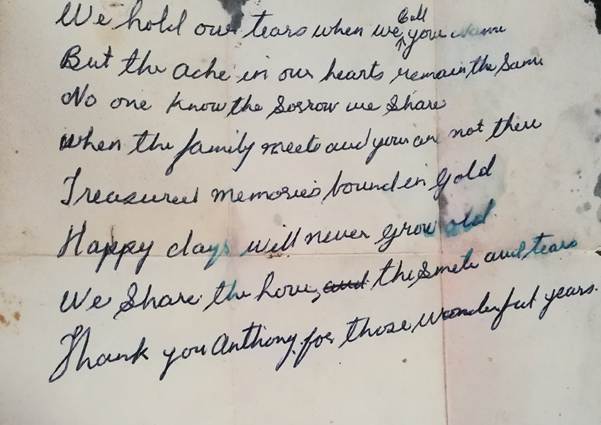
We hold our tears when we call your name
But the ache in our hearts remain the same
No one know the sorrow we share
When the family meets and you are not there
Treasured memories bound in gold
Happy days will never grow old We share the love, and the smiles and tears
Thank you Anthony, for those wonderful years.
I would also note that this article is itself a product of healing. Writing it has been a profound tool for processing and releasing the trauma of my brother’s death. It is my hope that in sharing this story, others may find permission to do the same — to write, to speak, and to heal.
Dedicated to both my brother and my father.
Dearly loved, dearly missed.
About the Author
Rae Sharman Sampson-McMillan, LCSW-R, is a Licensed Clinical Social Worker based in New York with a career spanning NYC Child Welfare and Emergency Domestic Violence Services in clinical, management, and executive leadership roles, including having served as Chief of Staff in the Division of Child Protection within the NYC Administration for Children’s Services
(ACS) — one of the largest child welfare agencies in the United States. She holds a Master’s
Degree in Social Work (MSW) from Columbia University and a Bachelor’s Degree (BSc) from
Fordham University, and is the recipient of the NASW-NYC Mid-Career Exemplary Leadership Award. She is the originator of Oppressiveisms™, a word she coined in 2002, and the developer and author of its framework — A Transformative Framework: Magnified, Collective, Clarified and Inclusive for Social Justice and Public Well-Being — further explored at
oppressiveisms.com. She has authored and published related Oppressiveisms™ articles.
Email your opinions, letters and commentaries to: letters@caribmagplus.com
“I am deeply grateful to Caribbean Magazine Plus for publishing this article — a story that has lived in my heart for over half a century. Writing it has been a profound part of my own healing journey, a reminder that putting pen to paper can be a powerful tool for processing grief, trauma and the questions that quietly shape our lives.
At its core, this is a story about fatherhood and parenting — about the love that fathers carry, sometimes expressed in ways that leave little room for a child’s vulnerability, and the importance of creating spaces where children feel safe enough to speak their truth, even in their most desperate moments. It is a conversation our communities need to continue having.
It is my sincere hope that in reading this reflective writing piece, others may find permission — permission to speak, permission to ask the difficult questions, and permission to heal.
With gratitude and continued blessings to the wonderful Caribbean community and beyond — inclusive of all readers whose lives this story may touch.
Rae Sharman Sampson-McMillan, LCSW-R
Originator, Oppressiveisms™
oppressiveisms.com
Thank you for sharing such a personal and painful story with such honesty. I found myself thinking about it long after I finished reading.
I agree with the central thread of what you’re pointing toward: a child’s sense of safety with a parent isn’t the same thing as that parent’s love, or even their protectiveness. Anthony telling your mother and not your father speaks to that distinction exactly — he may have trusted her not because she was more present, but because disclosure felt less costly with her. That’s a distinction I think a lot of us who grew up under “tough love” parenting recognize immediately, even if we’ve never put words to it.
Where I found myself pausing was on how much weight a single, unrecoverable moment is being asked to carry. We can’t actually know why Anthony stayed silent — it could have been fear of punishment, but it could just as easily have been shame at having disobeyed, or a child’s instinct to minimize what he thought was a minor problem, or simple denial. I don’t think that uncertainty weakens what you’re saying about fear-based parenting in general, but I think it’s worth holding those possibilities alongside each other rather than letting the silence settle too neatly into one explanation.
What stayed with me most, honestly, is the tension you don’t fully resolve: your father’s warnings weren’t cruelty for its own sake — they were survival information for a genuinely dangerous place, delivered by a man raising six children alone with no safety net if something went wrong. So the real question your essay raises for me isn’t “was it fear or was it love” — it’s how a parent makes a warning serious enough to be heeded without making it so frightening that a child would rather stay silent than admit they didn’t. I don’t think there’s an easy answer to that, and I don’t think you’re claiming there is. But I would have liked to see you sit with that tradeoff a little longer, because it feels like the real inheritance of this story — not just for your family, but for anyone parenting under pressure with high stakes and few resources.
The image of your father, years later, learning to hug and say “I love you” — and the poem he never spoke aloud — says more than any argument could. It suggests the capacity for that kind of tenderness was always there, just waiting for a script that his own upbringing never gave him. Men were expected to be tough…. showing emotion was a sign of weakness. He was exemplifying how he was raised as a child.
Thank you again for writing this. It’s given me a lot to think about, both as a reader and as it relates to my own family.
Dear Gee Gee,
Thank you so much for this reflective and generous response — and for sitting with the story long enough to let it raise questions of your own.
You have touched on something important — the uncertainty surrounding Anthony’s silence. You are absolutely right that we cannot know with certainty what kept him quiet in those final days. The article raises that very question without claiming to answer it definitively. Was it fear? Shame? A child’s instinct to minimize? Perhaps all of these, layered upon each other in ways we may never fully untangle. That uncertainty is itself part of the story — and part of what has stayed with our family for over half a century.
Your framing of the central tension is one I find particularly compelling — not “was it fear or was it love” but rather how does a parent make a warning serious enough to be heeded, without making it so frightening that a child would rather stay silent than speak. That is perhaps the most honest question this story raises, and one for which there are no easy answers — then or now.
You are also right that our father’s warnings came from a place of genuine protectiveness — a man raising six children alone, with real dangers and no safety net. His tough love was survival parenting, shaped by everything his own upbringing taught him about what strength and fatherhood required.
And yes — the poem and that eventual “I love you” say everything. The capacity for tenderness was always there. It simply needed room — and a script his own upbringing never gave him.
Thank you for reading so carefully, and for sharing how it connects to your own family. That is exactly what this story was written to do.
With warm regards,
Rae.
Rea, this is a deeply moving essay about loss—the loss of a son, a brother, a friend, and a cousin. Such a profound loss had to be transformative for the entire family, particularly for the parents who lost a child and the siblings who lost a brother.
There are so many layers to unpack. The essay invites reflection on transnational parenting and the emotional consequences of family separation. It also raises important questions about the economic and structural forces rooted in colonialism that have compelled Caribbean families to migrate in order to provide financial support for loved ones.
Additionally, the essay evokes the legacy of Caribbean parenting practices, particularly corporal punishment, which many scholars trace to the enduring influence of slavery. During enslavement, parents often sought to ensure their children’s survival by emphasizing strict obedience and compliance in an environment where any perceived defiance could have devastating consequences, including family separation through sale. This historical legacy continues to shape parenting practices that value being “seen and not heard,” rewarding compliance, obedience, and being “the good child.”
The essay also prompts reflection on the sacrifices that many Black children have historically made, often being denied the freedom to explore, question, and take age-appropriate risks—experiences that are essential developmental milestones.
Equally compelling is the essay’s treatment of grief and the ways many Caribbean, Black, and Brown families experience and express it. It highlights the expectation that one must keep moving forward, often without the opportunity, language, or support to process profound loss. Rather than seeking formal grief counseling or mental health services, grief is frequently carried quietly within families and communities, with resilience becoming both a strength and an expectation. The essay also raises important questions about gendered expectations surrounding grief—how men and women may be permitted, encouraged, or discouraged from expressing sorrow differently, and how these cultural norms shape mourning, healing, and emotional well-being across generations.
What is also subtly woven throughout the essay is the role of a child’s position within the family, particularly in Caribbean families, and the expectations placed on children based on birth order and gender. It made me wonder what messages your brother received—from within the family, the broader culture, and prevailing ideas of masculinity—that led him to keep his injury a secret. Was it solely fear of his father’s wrath, or was there something more? Was he trying to be brave, to avoid disappointing his parents, to protect them from worry, or to live up to expectations of what it meant to be a “good” son? These unspoken messages and cultural expectations are powerful, and your essay opens the door to exploring how they shape children’s decisions, often with life-altering consequences.
These interconnected themes enrich the narrative and underscore how personal grief is inseparable from historical, cultural, and structural realities. Your essay is not only a moving account of individual and familial loss, but also an invitation to reflect on the broader social forces that shape how Caribbean families love, sacrifice, parent, grieve, and endure.
Dear Christiana,
Thank you so much for this deeply thoughtful and generous response. Your academic lens brings a richness and breadth to this conversation that is both humbling and deeply appreciated.
You are absolutely right — there are many layers woven throughout this story, some intentional and some that simply emerged naturally from lived experience. The intersections of transnational parenting, colonialism, the historical legacy of corporal punishment, gendered grief, birth order, and the unspoken cultural messages our children carry — you have named them all with such clarity and care.
The article was written foremost as a personal reflection. A window into the loss of a brother, and the quiet but profound question of whether fear played a role in a tragedy that has stayed with our family for over half a century.
The question of what messages Anthony received — beyond fear of our father — about what it meant to be a good son, a brave boy, a strong child — have no simple answers. What I can say with certainty is that our father deeply loved Anthony. He was also, by all accounts, a spirited and challenging child who needed and received firm parenting as best as dad knew how. Perhaps the messages he carried were shaped by that very dynamic — love expressed through firmness/tough love, and a child navigating what that meant for him in his most vulnerable moment.
Your response beautifully confirms that this article is not an ending — it is a beginning. And I am grateful to you for helping open that door wider.
With warm regards and deep appreciation,
Rae.