
By: Staff Writer
August 18, 2026
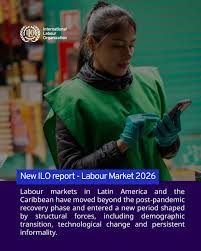
The International Labour Organisation in a recent report said that regional unemployment in the Latin American and Caribbean (LAC) region reached its lowest levels in recent decades.
The report, “Labour Market Trends in Latin America and the Caribbean,” said: “The regional unemployment rate reached one of its lowest levels in recent decades. Unlike in the years immediately following the pandemic, when the improvement in the labour market was driven mainly by rapid growth in employment and the labour force, in 2025 the fall in unemployment was also due to slower growth in labour supply, linked, among other factors, to demographic transition and changes in the composition of the working-age population.
“Although gender gaps in labour force participation, employment and unemployment continued to narrow, women still face barriers to entering and remaining in employment, which are closely linked to the unequal distribution of care responsibilities.”
Ana Virginia Moreira Gomes, ILO Regional Director for Latin America and the Caribbean, said: “A microenterprise struggling to survive does not face the same barriers as a business with the potential to grow that continues to operate informally. Effective responses therefore require a more precise diagnosis and a combination of policy instruments tailored to the needs and capacities of each group.”
The report continued: “The decline in unemployment observed in the regional average was widespread across subregions and countries, although it reflected differing labour supply and demand dynamics. This diversity of trajectories confirms that changes in the unemployment rate can only be properly interpreted when analysed alongside changes in labour force participation and employment.
“Similarly, young people continue to experience higher rates of unemployment and informal employment than the adult population, and face difficulties in making the transition from education to quality jobs in a context marked by rapid technological change.”
The decline in the informality rate in 2025 is a favourable sign, as it points to a gradual formalisation process and an improvement in the composition of regional employment. However, behind this regional average, deep differences between countries remain, showing that formalisation processes require differentiated policy responses depending on the level of labour market development, the type of labour market attachment, the characteristics of economic units and the specific features of different territories.
Informality is not a uniform reality for all. Some businesses generate incomes that are too low to cover the costs of operating formally, while others have the capacity to formalize but lack sufficient incentives or perceive few benefits in doing so. In addition, part of informal employment exists within registered enterprises that do not formalize all employment relationships
Against this backdrop, employment policies must also evolve. Alongside promoting job creation, governments need to simultaneously strengthen productivity, support formalization, expand skills development and reinforce social protection.