
By: Staff Writer
October 24, 2025
The Inter-American Development Bank (IDB) in their recently published Caribbean Economic Quarterly bulletin said when the Caribbean is compared with the growth trajectory of Panama, for example, which is growing at a 5 percent growth rate, it could take the region decades to double in size when it is averaging just under a 2 percent growth rate.
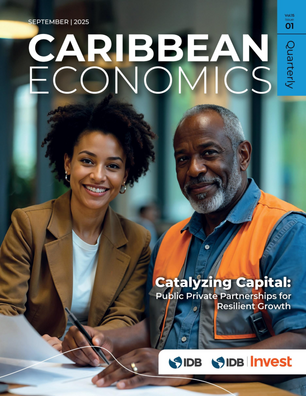
The report, “Catalyzing Capital: Public-Private Partnerships for Resilient Growth,” said: “Of the five IDB Caribbean Department economies for which data are available, only Guyana’s potential output was about equal to the Latin America and Caribbean average of 2.8 percent per year, based on the latest estimate from 2017, which was prior to the beginning of production and financial flows linked to the discovery of hydrocarbon resources.
Therefore, Guyana’s potential output is likely much higher today. Potential output for Barbados, Jamaica, The Bahamas, and Suriname (latest estimates for 2021) were in some cases considerably below the regional average, and near the bottom of the global rankings.
“For example, under ideal conditions, it could take the real economy of Panama—the Latin American and Caribbean economy with the fastest estimated potential real output growth rate of 5 percent per year (2021)—15 years to double in size (including per capita income).
“But for Caribbean economies whose estimated potential growth rates are generally in the 1 to 2 percent range, it could take many decades for their economies and living standards to make similar progress unless significant efforts are made to meaningfully increase potential output.”
Caribbean countries have long grappled with fiscal and debt vulnerabilities, which have constrained public investment in critical infrastructure and social services. The report also emphasizes that since 1970, Caribbean economies have averaged less than 2% annual growth in real gross domestic product.
Using IDB-developed methodologies, the report quantifies infrastructure development gaps across key sectors and estimates the Caribbean will require more than $21 billion in infrastructure investment by 2030.
“Countries across the region need significantly larger volumes of private investment, expertise, and innovation to drive faster and more inclusive growth. This report highlights key sectors—including transport, water and sanitation, energy, and digital telecommunications infrastructure—that are most critical for sustainable growth and best placed to benefit from PPPs, as well as areas where focused reforms are most likely to deliver results,” said Anton Edmunds, IDB General Manager for the Caribbean.
“The IDB Group and our ONE Caribbean regional program can provide countries and firms with financial, technical, and project preparation support needed to help catalyze new investments in these and other priority sectors,” added Edmunds.
Surpassing US$21 billion in infrastructure investment by 2030 could generate additional economic growth exceeding $84 billion across the region. These estimates exclude additional investments needed for social infrastructure such as schools and hospitals, suggesting actual needs may be even greater.
Innovative financing solutions and public-private partnerships (PPPs) are key to unlocking the Caribbean’s development, according to the report. Investment in smart, resilient, well-executed infrastructure projects will both help insulate the region from global economic shocks, as well as drive faster and more inclusive growth.
Given limited fiscal space and heightened exposure to natural disasters, the report emphasizes the critical role of PPPs in mobilizing private capital and delivering high-quality infrastructure. Drawing on global and regional experience, the IDB outlines how PPPs can enhance efficiency, reduce costs, and accelerate innovation.